Is AI Adoption and Implementation or Governance Question?
Think twice!

Two numbers came out of a March 2026 HBR study that I haven’t stopped thinking about this week.
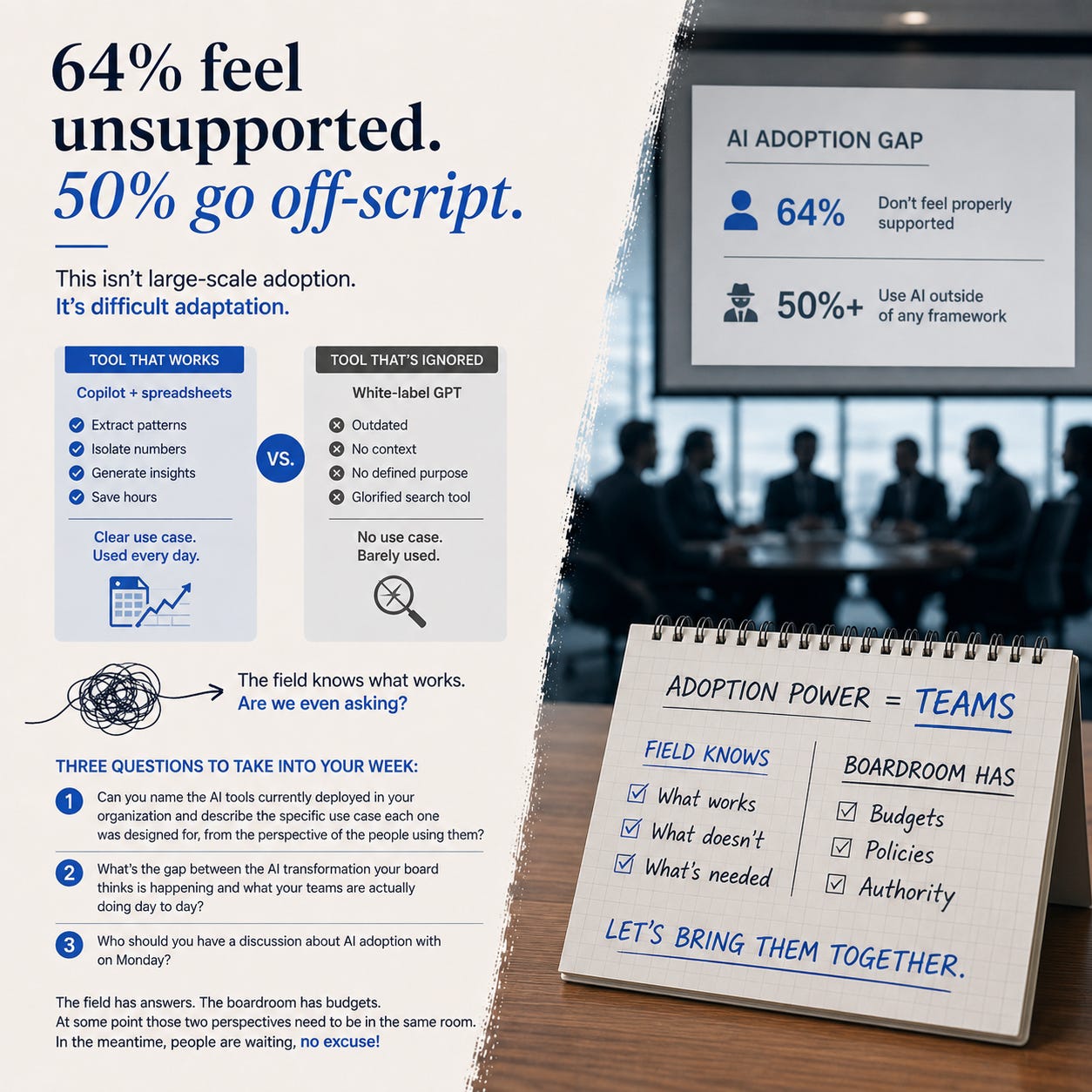
One, 64% of employees say they don’t feel properly supported through their company’s AI transformation. And two, more than half report using AI tools outside of any company framework, without guardrails, without guidance, on their own terms.
Read those two together: what you get isn’t large scale adoption as many commentators suggests, it’s rather difficult adaptation and complex governance.
Your people aren’t against AI but they’re not really leveraging it either, they are simply figuring it out.
Why? Most likely because they are waiting for a framework that hasn’t arrived yet!
For instance, I had a conversation recently with a lead market data analyst at a large company. When the subject turned to AI, she gave me an embarrassed face and said they weren’t using it much. I dug into that so she agreed to show me what her team actually uses.
Tool one: Copilot connected to internal spreadsheets. Her team uses it every day to extract patterns, isolate numbers, come up with insights nobody really considered and produce conclusions from complex data tables. Conclusion, they save hours and have a pretty clear use case.
Tool two: a white-label version of GPT, deployed company-wide. Outdated since an old version of the LLM was still running without any update, no ability to set context, no defined purpose attached to it apart from having a glorified search tool at their disposal. Conclusion, like most of her colleagues she opened it a few times, then stopped trying.
So that gives us two tools, with one decision coming from the top to deploy with the rank and field that apparently never happened.
The part that struck me about that conversation? She wasn’t frustrated and she wasn’t complaining. She’d just selected what worked and quietly set aside what didn’t, while the global group she worked for had moved on without noticing.
So, while we hear constantly about companies replacing headcount with algorithms, why is it that we spend so little time on the most common situation: companies that deployed AI without defining what it was for, and whose teams have already figured out the answer on their own?
As I wrote yesterday in a LinkedIn post, the fish is moving faster than the organizations trying to catch it, while the people closest to the water who already know which tools work haven’t been asked. That sounds rather silly to me.
The 64% who feel unsupported aren’t just unsupported because of a training gap. They’re unsupported because nobody above them answered the foundational question before the tools went live. What changes for your teams when AI enters their work? What happens when the old way and the new way collide? Who decides, and based on what?
Those aren’t just implementation questions, they also touch upon governance questions that need answers from the Board, HR and information systems directors.
Imagine the consequences of that, though? An analyst using their own 20$ AI to save time on confidential data management? A marketing junior drafting social media posts using AI, without a proper context and AI workflow thus leading to wrong brand voice and communications? An in house lawyer repeatedly using AI to correct tiny bits of a contract, without realizing that run after run other parts of that contract have been affected?
Your teams have already done their own triage. They know what works. The question is whether anyone in the room where strategy gets decided has thought to ask them. That’s where the power of AI adoption lies these days: teams!
So, three questions to take into your week:
- Can you name the AI tools currently deployed in your organization and describe the specific use case each one was designed for, from the perspective of the people using them?
- What’s the gap between the AI transformation your board thinks is happening and what your teams are actually doing day to day?
- Who should you have a discussion about AI adoption with on Monday?
The field has answers and the boardroom has budgets, at some point those two perspectives need to be in the same room. In the meantime, people are waiting, you have no excuse!