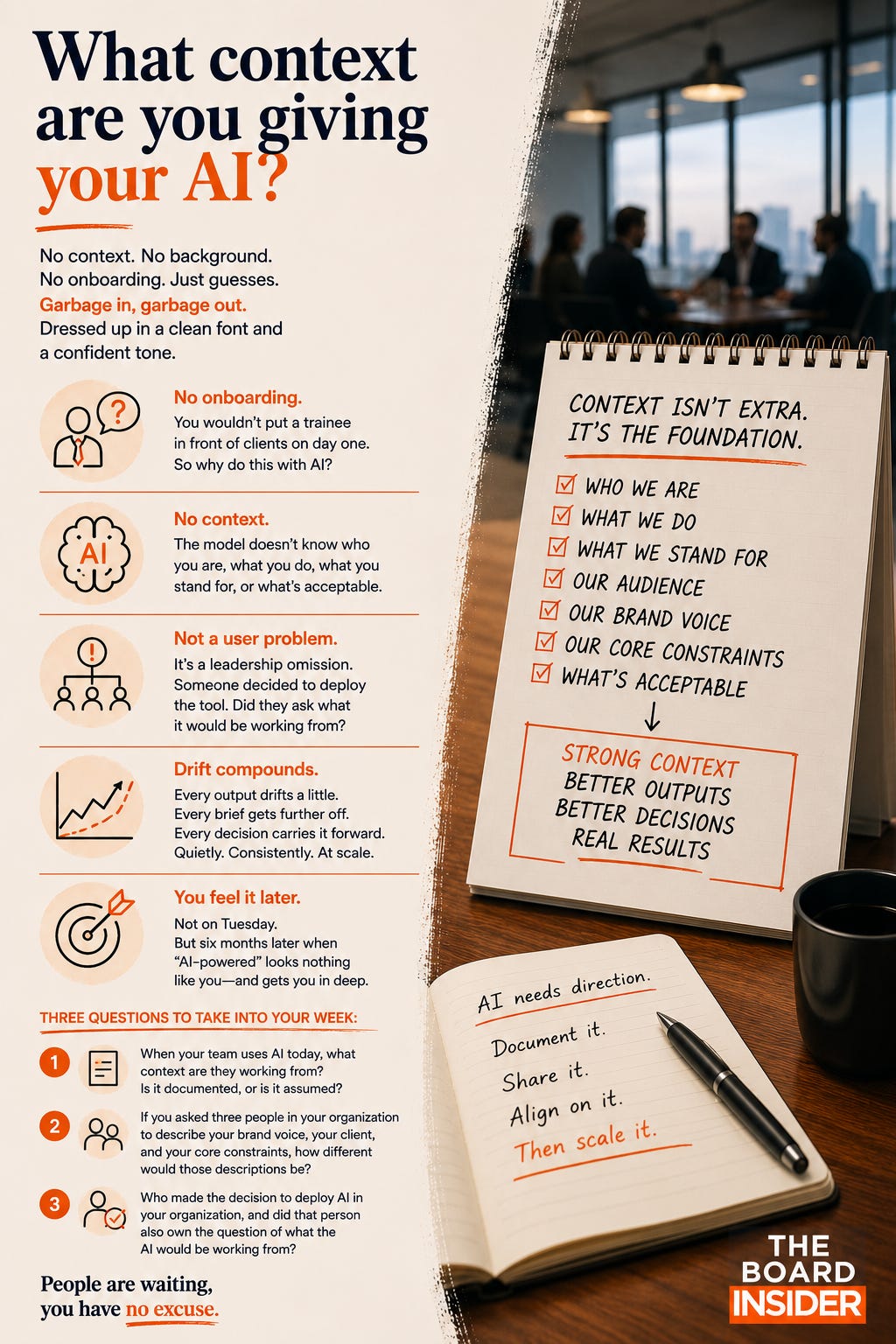
You gave your team AI. Did you give them context?
The onboarding question nobody asked (and why that's a shame)

Would you rather listen an audio version of this post? There you go. AI recording here.
You rolled out AI in your company and your teams are using it. Outputs are being produced, decisions are being made based on those, and the whole thing looks like it's working. But here's the question nobody asked when the deployment went live: what context did you give the model to work from? Have you provided your AI and teams with some documented background clarifying who you are, what you do, what you stand for and what’s acceptable? Most companies don’t do that because they have no clue. But the truth is simple: their AI is just filling the gap with something it made up and they will pay the price for that sooner than later.
I co-hosted a workshop on AI and marketing strategy for fifteen professionals last week. Marketers, consultants, a few founders and two CMOs. All sharp people really, and one expectation: tips on getting better outputs, faster results, sharper copy.
Except I opened with a different question.
How many of you have built a proper context base for your AI? Something that tells the model who it's working for, what the constraints are, what the brand sounds like, what actually matters?
Two hands went up, out of fifteen.
Most were discovering the concept. They were looking ahead, hoping for solutions to move forward faster, but they hadn’t thought of documenting some context the AI could use as a solid foundation for the rest.
Anna, a CMO in the room had been watching this gap play out for months with her clients and got into the conversation with me. “They produce AI outputs, present them as analysis, make decisions from them because the output looks authoritative”, she said, “but nobody realizes that since there’s no strong basis the models are just inventing something convincingly wrong”.
In plain English? Garbage in, garbage out, dressed up in a clean font and a confident tone.
My take in this? You wouldn’t hire a trainee and put them in front of clients on day one without onboarding, right? Still, that’s exactly what most companies do when they roll out AI.
They give their teams the tool, they skip the onboarding and leave people to it.
The AI has no context, no background as to what the company does and what it needs to be about. And the teams, without training, start to produce things and make decisions from those things without the slightest oversight.
This could sound like a user problem, but it really isn’t.
When AI gets deployed without context, the instinct is to blame the people using it. They don’t know how to prompt, they need training, they’re not curious enough.
Except that the decision to deploy without documentation wasn’t made by them. Someone above decided the tool was ready to roll out, but did they ask something like “oh, but, what are we giving it to work from?”.
Nope.
Said differently, that’s an omission at the top rather than a competence failure. And the issue is that this kind of omission compounds fast, because every output produced from an empty context drifts a little further from what the company actually is.
Every marketing brief or production gets a little farther from what the brand is about. Ask Anna!
And every decision made from that output carries the drift forward.
All of this quietly, consistently, and at scale.
You don’t feel it on Tuesday, but you feel it six months later when something produced from your “AI-powered” process looks nothing like you and gets you in deep.
So, three questions to take into your week:
When your team uses AI today, what context are they working from? Is it documented, or is it assumed?
If you asked three people in your organization to describe your brand voice, your client, and your core constraints, how different would those descriptions be?
Who made the decision to deploy AI in your organization, and did that person also own the question of what the AI would be working from?
People are waiting, you have no excuse.